
Smart Factory Teaching Lab Platform
Build an Industry 4.0 smart factory model by combining Internet of Things (IoT) big data collection with robotics and machine vision.
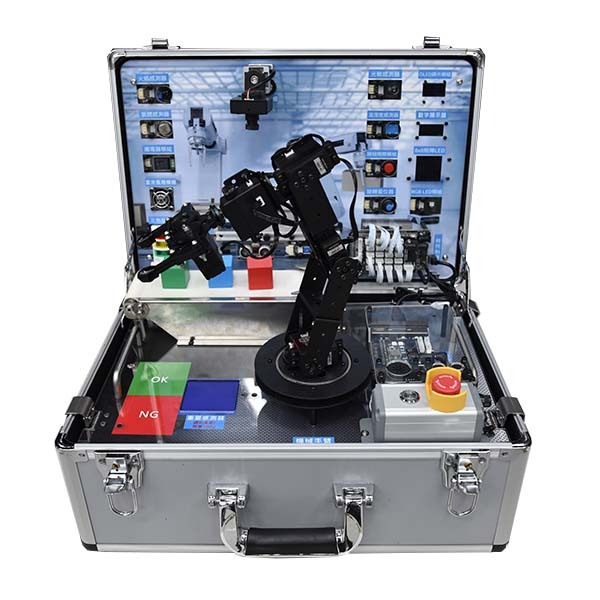
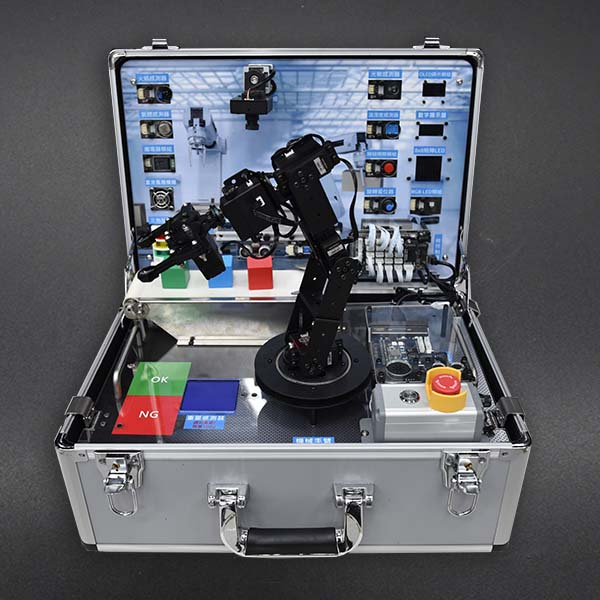
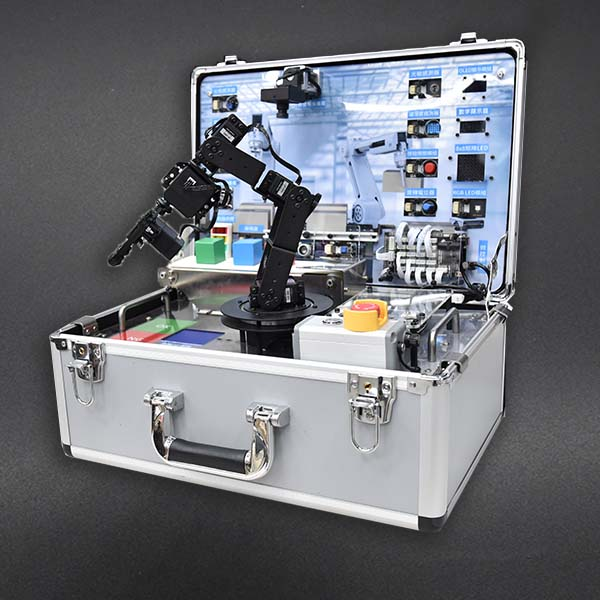
Product overview
The core of a smart factory based on Industry 4.0 is the cyber-physical system (CPS), which uses the Internet of Things to achieve smart manufacturing. The Smart Factory Teaching Lab Platform builds a simulated smart factory scenario for teaching and on-site demonstrations. Combined with progressive, theme-based lessons, it strengthens students’ practical AIoT skills and prepares them for related fields.
The teaching kit covers smart factory technologies including industrial IoT, artificial intelligence, cloud big data, machine vision, and robotics. It can be used in foundational subjects such as Arduino microcontrollers, Raspberry Pi microcomputers, programming languages, and electronic circuits, as well as specialized courses such as smart sensors, machine learning, digital image processing, and robot control.
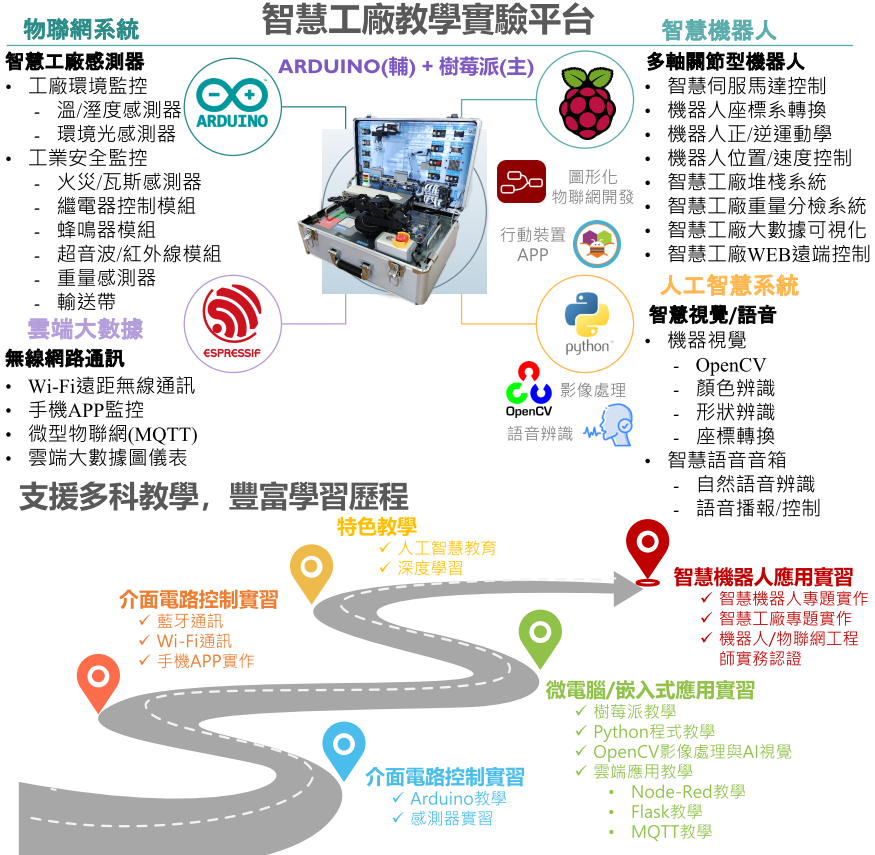
Platform components
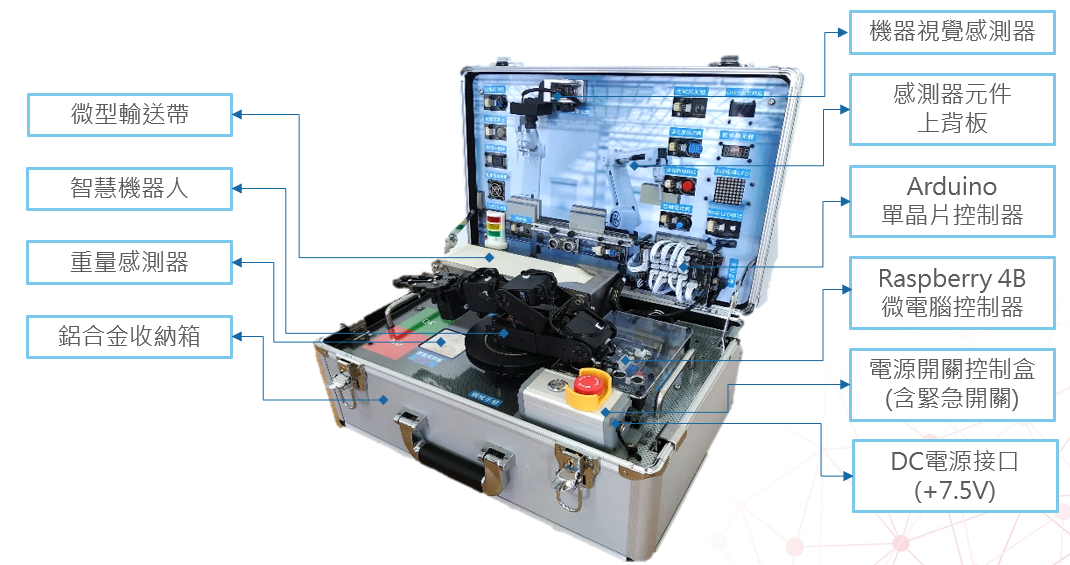
The platform consists of five major modules:
- Smart factory sensor components
- Smart factory controllers: Arduino microcontroller (secondary) + Raspberry Pi microcomputer controller (primary)
- Intelligent robot (multi-axis articulated robot, micro conveyor belt, weight sensor)
- Machine vision sensor
- Intelligent speech recognition / announcement module
Sensor components
Sixteen sensor components are provided, in three categories. All sensors come pre-connected to the Arduino signal expansion board, so students skip complicated wiring and go straight to learning sensor principles and data collection programs.
| Environmental monitoring components | Sensing / control components | Indicator / data display components |
|---|---|---|
| Temperature sensor | Ultrasonic sensor | RGB LED |
| Humidity sensor | Infrared sensor | Three-color indicator light |
| Ambient light sensor | Relay module | LED matrix module |
| Flame sensor | Push button | OLED module |
| Gas sensor | Weight sensor | Digital display |
| Buzzer |
Simulated smart factory production line scenario
The kit’s integrated physical-and-virtual system simulates a smart factory production line, letting students experience how a smart factory operates in a safe setting:
- Smart factory stacking system
- Smart factory weight sorting system
- Smart factory cloud big data visualization
- Smart factory web remote control system
What this kit teaches
IoT systems
Factory environment monitoring (temperature and humidity, ambient light) and industrial safety monitoring (fire / gas, relay, buzzer, ultrasonic / infrared, weight sensor, conveyor belt).
Cloud big data
Wi-Fi long-range wireless communication, mobile app monitoring, lightweight IoT with MQTT, and cloud big data dashboards.
Intelligent robots and AI
Coordinate transformation and forward / inverse kinematics for multi-axis articulated robots; color and shape recognition with OpenCV machine vision; speech recognition and speech announcements.
Course outline
01 Industry 4.0 (1 class period)
Unit content
- Introduction
- Evolution and trends of Industry 4.0
- Three core areas: smart factory, smart production, and smart logistics
- Technology overview
Matching materials: Smart Factory Teaching Lab Platform User Manual, Chapter 1 (pp. 10–14)
02 Smart Factory (1 class period)
Unit content
- Introduction
- Characteristics of a smart factory
- Key smart factory technologies
- Smart factory benefit analysis
Matching materials: Smart Factory Teaching Lab Platform User Manual, Chapter 2 (pp. 15–20)
Further reading: Smart Factory Teaching Kit Series (1): Feature Overview
03 Smart Factory Teaching Lab Platform (3 class periods)
Unit content
- Sensor components
- Arduino microcontroller (Arduino Mega 2560, ESP8266)
- Raspberry Pi microcomputer controller
- Intelligent robot, machine vision sensor, and intelligent speech recognition and announcement module
- Smart factory development environment setup
Matching materials: Smart Factory Teaching Lab Platform User Manual, Chapter 3 (pp. 21–41)
04 IoT perception layer practical techniques (8 class periods)
Unit content
- Initial Arduino environment setup
- Smart factory environment monitoring: photoresistor, temperature / humidity sensor
- Smart factory safety monitoring: gas, flame, relay, passive buzzer, ultrasonic, infrared
- Display and input: OLED display, three-color indicator light, digital RGB LED, digital display, rotary potentiometer, 8×8 LED matrix, weight sensor, push button
Matching materials: Smart Factory Teaching Lab Platform User Manual, Chapter 4 (pp. 42–101)
Further reading: Smart Factory Teaching Kit Series (2): Industrial IoT Perception Layer Practical Techniques
05 IoT network layer communication principles (1 class period)
Unit content
- Wi-Fi wireless local area network
- Bluetooth communication
- Industrial IoT MQTT communication protocol
- Industrial IoT Modbus communication protocol
Matching materials: Smart Factory Teaching Lab Platform User Manual, Chapter 5 (pp. 102–107)
06 IoT application layer practical techniques (6 class periods)
Unit content
- Node-RED, a visual development tool for IoT
- Node-RED and Arduino serial communication, smart factory big data visualization
- Industrial IoT MQTT communication protocol lab
- Industrial IoT Modbus TCP communication lab
Matching materials: Smart Factory Teaching Lab Platform User Manual, Chapter 6 (pp. 108–151)
Further reading: Smart Factory Teaching Kit Series (3): Industrial IoT Application Layer Practical Techniques: Using Node-RED-Dashboard; Smart Factory Teaching Kit Series (4): Industrial IoT Application Layer Practical Techniques: Using Node-RED-MQTT
07 Intelligent robot practical techniques (4 class periods)
Unit content
- Robot coordinate systems
- Robot kinematics and the D-H convention: forward kinematics, inverse kinematics
- Smart servo motor speed / torque control and internal parameter monitoring
- Smart factory stacking system lab
- Smart factory weight sorting system lab
Matching materials: Smart Factory Teaching Lab Platform User Manual, Chapter 7 (pp. 152–176)
08 Machine vision practical techniques (5 class periods)
Unit content
- Basic OpenCV operations
- Color recognition lab
- Contour recognition lab
- Center-point calculation lab
- Machine vision and robot collaboration lab
Matching materials: Smart Factory Teaching Lab Platform User Manual, Chapter 8 (pp. 177–211)
09 Speech recognition practical techniques (3 class periods)
Unit content
- Automatic speech recognition (ASR) lab
- Text-to-speech (TTS) lab
- Voice-controlled robot lab
Matching materials: Smart Factory Teaching Lab Platform User Manual, Chapter 9 (pp. 212–231)
10 Mobile app development practical techniques (4 class periods)
Unit content
- Python Flask web back-end framework
- HTML templates and the Bootstrap front-end framework
- Smart factory live video streaming lab
- Intelligent robot remote control lab
- Mobile app implementation
Matching materials: Smart Factory Teaching Lab Platform User Manual, Chapter 10 (pp. 232–258)
The course outline is based on the chapters of the Smart Factory Teaching Lab Platform User Manual. Class period counts are estimated from page counts (1 period per 8 pages) and can be adjusted to fit your class.
Curriculum alignment
The content applies to these Taiwan 108 Curriculum Guidelines courses: “Interface Circuit Control Practicum,” “Microcomputer / Embedded Application Practicum,” “Intelligent Robots,” and “Project Implementation.”
Teaching articles
- Smart Factory Teaching Kit Series (1): Feature Overview
- Smart Factory Teaching Kit Series (2): Industrial IoT Perception Layer Practical Techniques
- Smart Factory Teaching Kit Series (3): Industrial IoT Application Layer Practical Techniques: Using Node-RED-Dashboard
- Smart Factory Teaching Kit Series (4): Industrial IoT Application Layer Practical Techniques: Using Node-RED-MQTT
Contact us
Your message goes straight to our team, and we usually reply within one business day.
- 01Questions? Send us a message or add us on LINE.
- 02Quotes and orders, including international shipping
- 03Teacher training and professional development

Scan with your phone to add us on LINE.
Add us on LINE